Showing posts with label Fantasy Film and Game Reviews. Show all posts

Thursday, May 1, 2014

Alice: A SyFy miracle

Alice-Syfy
Okay so let me inform you on one (and possibly the only) good thing that has come out of the SyFy network. Once upon a time there was a girl named Alice who had a named Jack. One day while eating dinner with her mother, Jack gives Alice a ring and tells her that even if she doesn't want to marry him to keep it. Though she denies at first after he leaves Alice decides that she in fact does want to marry her love Jack however when she does catch up to him she sees him being dragged into a mirror and seemingly go to the other side.
Alice determined to find her love goes through the mirror only to find out that it is one of the looking glasses in the world, the kingdom is based on a “house of Cards”, her dad is alive, the people here feed off of human emotions and that the mad hatter is actually a cute honorable man. She is forced to be the new Alice in Wonderland and she must bring down the queen of hearts (Jack’s mother) in order to save everyone including her father who had been missing for over 20 years. Alice is a changed woman when she finally gets back, she is in love and her dad gives her the strength to live on.

This is a unique type of a film because it is a small miniseries that spans over three episodes becoming close to a four hour movie. It is well done and lacks the usually cheesy radioactive monsters that SyFy enjoys so much. I love this story and it is a great take on a modern day Wonderland.


Hook: A timeless Reminder

Hook

This movie is based on the idea that Peter Pan eventually does grow up, he leaves Neverland to grow older and become a business man with a fear of heights. Now Peter Banning the goes back home to England, his orphanage and the woman who took care of him when he was first found … Wendy Darling. He, his wife Moira and their two kids Jack and Maggie go to honor Wendy as she accepts a new award from a hospital. As the adults are away the famous Pirate Captain James Hook takes Banning’s kids to never land holding them in anticipation of Peter Pan’s return.


                When I first watched this movie I was a child and it was beautiful, enchanting, and everything you could think of in-between. Peter Banning must learn to accept who he was and revert back to when he could play as Pan to save his kids. As a kid it made me think of all the great things I could do as an adult without losing out on having fun when I grew up. As an adult this movie reminded me again that yes it is important to be an adult and grow up, but it is equally important to have fun. It was a great take on the fantasy of going back to child and never really growing up. It is a fun movie that serves as a reminder that life is the most important things. You have to grow up so learn to have fun as a kid, but you do have to grow up to remember that living and surviving are two different things and after that to remember “Death would be an awfully great adventure.”

Pan's Labyrinth: The Dark Fairy Tale

This is a fantasy realm so fully and elegantly realized, it might have been a classic novel, but it was Del Toro’s imagination. Del Toro calls Pan's Labyrinth a dark fantasy for adults, because the violence it contains is certainly not suited for children.  The col-blooded attacks of the Captain towards others (he shoots a rebel after smashing his face unrecognizable with a broken bottle) and himself. The scene where he, after having his own cheek cut open, sutures it by himself and takes a swig of tequila, is both brutal and Oscar-worthy. Brilliant cinematography, Del Toro juxtaposes the reality of war to the fantasy world and somehow shows the audience that the fantasy world is more real and life like than reality. He uses contrasting color like bleak washed out cool colors for the outside world and lively, bright warm colors for the fantastical world. This film was a commentary on war as well as September 11th.

For much of the film, Ofelia's fairy-tale quest is secondary to the power struggles in the house with a checkerboard like interaction yet seamless filming. Tensions bubble between the Captain and Ofelia's weak mother, and especially the Captain and the housekeeper Mercedes. The captain is a sociopath, obsessed with small details on using his magnifying glass and pouring over the watch his father gave him. In his psychotic obsessions, he misses the big details of the world. The faeries and fawn are ambiguous and neither good nor bad. The nurse Mercedes is good, even as she rebels because she values human life.

It is a fantasy film because there is the element of magic through the fairies and the book the fawn gives. The womb is the entry of fantasy world, and there are reoccurring images of fallopian tubes and placental tones. Even the fairies are organic. The tree is a reference to Alice in Wonderland. Magic affects the real world when the book predicts the miscarriage. Music in that scene is reminiscent of Pink Floyd’s “Is Anybody Out There?” eerie intro. Ofelia realizes the power of magic and that no matter what, she must trust her instincts. Disobedience to the majority of societal pressures leads to the right door opening (with the key and freedom).

Ogres eat innocence, even though they have a feast of food set out before them. This whole scene is the echo of the feast the captain has with all of the people, even though most people are boiling roots to survive. All of the characters are at crossroads in the movie, which is when they decide to put childish toys away and lose a part of their soul. This is the melancholy truth of becoming an adult. It is not the tests, but how Ofelia approaches the tests makes the difference. In the end the captain becomes human when he asks for the rebels to tell his son who he was, and Mercedes replies he will never know your name. This kills him before the bullet does.  Ofelia becomes immortal because she made the right choice, which is to refuse death and its sting. Only if you dare to die, will you reach immortality. 

Monday, April 21, 2014

Analysis of HP 7 Part 1 and an overall outlook at the themes.

I think it’s fair to say that few books have ever inspired as much controversy as J.K. Rowling’s hugely popular “Harry Potter” fantasy series. With more than 400 million copies sold, the books have impacted popular culture in a massive way. And, of course, they’ve attracted praise and scorn from virtually all sides, including an almost unprecedented amount of criticism from the conservative Christian community.
Five years ago, I began reading the series suspiciously, expecting to encounter a barrage of subversive, anti-Christian propaganda(largely due to my mother’s ill response to the series). I’d read plenty of articles about the “occultism” of the series, and heard all the anti-”Potter” arguments. I was pleasantly surprised to find out that I’d been mistaken: the books were adventure stories in the style of Roald Dahl, with a layer of fairy-tale magic added on. I devoured the first six volumes, read the seventh book as soon as it came out, and moved on to other things. This past semester, I took the time to revisit the series from a more critical standpoint. The first time I read the books, I did so primarily for entertainment. The second time around, I was specifically looking for themes – and more specifically, I intended to write this commentary. This will necessarily be a fairly long discussion to explore the three predominant motifs and look at the First Deathly Hollows movie and how I believe it best portrays the themes throughout the series. I will reference book 7 more than the movie because I’m using more content from part one, as I have not yet seen part two and have yet to find the time to watch it.
 (Note: In order to evaluate the complex themes of this series, the following commentary contains spoilers)
SUMMARY:
I know we just read it but this is just here as a refresher. Feel free to skip this bit if you’d like. The “Harry Potter” series is the story of the eponymous hero, orphaned at birth and left in the care of the cruel Dursley family of “Muggles” (non-magical people). On his eleventh birthday, Harry receives a letter from Hogwarts, a school for young wizards and witches, and promptly enters a world of wonder and mystery. At Hogwarts, he meets his two closest friends – Ron Weasley and Hermione Granger – and begins studying magic. It soon becomes clear that the death of Harry’s parents was no accident: the evil Dark Lord Voldemort murdered them. Voldemort also attempted to kill Harry, but his attack rebounded on himself, severely crippling Voldemort’s power. The first few books of the series develop the characters and set the stage for Book 4, in which Voldemort returns to power and regains a corporeal body. Aided by his fellow evil wizards (“Death Eaters”), Voldemort begins a campaign to kill Harry Potter, the only one who may stand a chance of defeating him. The last three volumes deal with Harry’s increasingly desperate battle against Voldemort, and his fight to remain steadfast even as the world spins into chaos around him. It’s a fairly simple story arc, but the intricate web of plots and subplots grips the reader’s attention.
THEMES:
Throughout the course of the series, there are three fundamental concepts that drive the story: the power of love, man’s struggle against death, and the relationship between Harry and his mentor Dumbledore. Each of these deserves thorough evaluation.
1. The Power of Love
I feel almost infant writing on this specific instance but I find it unavoidable in this story of our near-Christ hero. One of the most recurring themes in the “Harry Potter” series is the sacrificial love of Harry’s mother Lily, who died to protect her infant son. Voldemort’s deadliest weapon, the “Killing Curse,” rebounded when he used it against Harry, shattering the Dark Lord’s power. In the final pages of Book 1, Voldemort cannot physically touch Harry due to the power of his mother’s love in him. Later in the series (after the Dark Lord’s return to power), Voldemort attempts to “possess” Harry but cannot due to the contrast between Harry’s soul and his own. Harry’s life is founded on his love for others, while Voldemort’s life is centered around hatred. Headmaster Dumbledore observes at one point: “That which Voldemort does not value, he takes no trouble to understand. Of house-elves and children’s tales, of love, loyalty, and innocence, Voldemort knows and understands nothing. Nothing. That they all have a power beyond his own, a power beyond the reach of any magic, is a truth he has never grasped.”
On a less complex level, love also repeatedly motivates acts of self-sacrifice on the parts of the main characters. Primary characters are willing to (and do) suffer unbelievable loss for one another, even giving up their lives in order to do the right thing. The love between family members is celebrated as beautiful and noble, never something to be mocked and sneered at.
However, the true significance of this theme does not emerge until Book 7(and movie 7 part one and part two).
Throughout the book, Harry, Ron and Hermione have successfully located and destroyed the six Horcruxes, magical objects bearing fragments of Voldemort’s essence. (While the Horcruxes exist, Voldemort cannot be truly killed.) However, it soon becomes clear that, in fact, a seventh Horcrux exists: Harry Potter himself. The curse that originally failed to kill Harry struck Voldemort instead, blasting away a piece of Voldemort’s tainted essence…which in turn bonded to Harry. While Harry lives, Voldemort cannot truly die.
The situation may be summarized thusly: Harry, a bearer of evil that is not his own, must suffer death at Voldemort’s hands.
The symbolism is almost explicit. While Harry is certainly not Christ himself, he is the books’ “Christ figure”, willingly enduring a sacrificial death in order to save others from evil. He chooses to lay down his own life to end the evil caused by another. Harry even observes: “I don’t want anyone else to try to help. It’s got to be like this. It’s got to be me.” While this motif is certainly common even in non-Christian literature, it gains special significance when viewed in light of another prevailing theme (to be discussed later).
This theme of sacrificial love applies on another level as well, through the character of Severus Snape. The often-irritable Potions teacher at Hogwarts, Snape frequently appears to be antagonistic towards Harry throughout the series (although, interestingly, he often intervenes to protect Harry during the darkest moments). In the closing pages of Book 6, Snape appears to be allied with Voldemort, lending credence to Harry’s longtime suspicions.
However, Book 7 finally provides the full story. Snape, a longtime admirer of Lily (Harry’s mother), was forced to watch as she married a man Snape deemed reckless and immature. To make matters worse, Lily asked Snape to watch over their newborn son in the event of her death. Since that point, Snape’s relationship with Harry has been a constant source of pain…yet Snape chooses to sacrifice his own feelings and defend a child he believes should have been his. This subplot is one of the most moving elements of the entire series.
2. Man’s Struggle Against Death
The “Harry Potter” series is, in many ways, a parable about the danger of desiring immortality. Voldemort is obsessed with the concept of living forever, no matter what the cost. This dark desire leads him down the path of villainy, transforming him from a disturbed orphan boy into the living incarnation of evil. He attains a sort of pseudo-immortality by constructing the aforementioned Horcruxes – but in order to do so, he must take a human life for every Horcrux he creates. Dumbledore sharply critiques this empty attitude towards life: “As much money and life as you could want! The two things most human beings would choose above all – the trouble is, humans do have a knack of choosing precisely those things that are worst for them.”
In contrast, Harry and his friends are unafraid of their own mortality. When Harry confronts Voldemort and suffers death at the Dark Lord’s hands, he awakens to find himself in a limbo-like state between life and death. There, he sees the mutilated soul of Lord Voldemort – an affirmation that souls are ultimately held accountable for their actions, and that the material world is but the precursor to something more. Death is seen not as an end, but rather as a beginning. As Dumbledore puts it: “It is the unknown we fear when we look upon death and darkness, nothing more.”
But for Harry, death isn’t the end. To complete the Christ metaphor, Harry is resurrected from the dead, defeats Voldemort once and for all, and saves the magical world. His death leads to the salvation of countless others.
3. Harry’s Relationship with Dumbledore
(Note: I am not going to explore the hot-button issue of whether Dumbledore is or is not homosexual. The issue was never raised or alluded to in the novels themselves; thus, for the purposes of this commentary, this will not be under consideration.)
I must confess that I missed the significance of this theme the first time I read the series. However, this is perhaps the most interesting and uniquely symbolic element of the entire seven-book saga. To offer some background, Professor Albus Dumbledore is the headmaster of Hogwarts School, and fulfills the role of a father to Harry. He helps Harry wage his battle against Voldemort, providing counseling and insight throughout the series. Their relationship can be analyzed on two distinct levels: as a metaphor for the relationship between God the Father and God the Son, and as a metaphor for the relationship between God and His people.
Throughout the course of Book 7, Harry struggles with the quest that Dumbledore has left him: finding and destroying Voldemort’s Horcruxes. In the same way that Jesus pleaded with God the Father in the Garden of Gethsemane to “take this cup from [Him]“, Harry struggles to understand the “cup” that Dumbledore has left him to bear. During his journey to face Voldemort and die at the Dark Lord’s hands (a sequence clearly inspired by the Garden of Gethsemane), Harry never questions Dumbledore’s authority or his command, but sincerely wrestles with issues of grief and loss. It isn’t a perfect analogy – for instance, it’s not as strong as the Aslan/Emperor-over-the-Sea allegory found in the “Narnia” books. However, the way in which Harry fulfills the task left him by Dumbledore is, to an extent, analogous to the way in which Jesus obeyed His Father’s will.
On another level, Book 7 also serves as a metaphor for the relationship between God and His people. After Dumbledore’s untimely “death” in Book 6, a series of rumors begin to fly regarding Dumbledore, questioning his authority and his wisdom. These rumors are strikingly similar to arguments leveled by those antagonistic toward Christianity. Harry must decide whom he trusts: Dumbledore, who is no longer directly there with him, or those who criticize him.
In total, these are the three themes that struck me most upon a rereading of the series. Careful readers may note that I’ve frequently referred to the seventh volume of the series in exploring these issues; however, these ideas are developed throughout the series as a whole. Book 7 successfully unites all these elements into a dramatic, triumphant finale. This isn’t to say that there aren’t other themes in the books. There are countless other elements worthy of analysis – race and class discrimination, civil disobedience, and the corrupting effect of power, just to name a few – but these three are perhaps the standouts from a Christian worldview standpoint.
 “Harry Potter and the Deathly Hallows – Part 1″, director David Yates’ third contribution to the eight-film franchise, is a rich, dark adventure story that transcends its genre. Just like its predecessor, “Half-Blood Prince,” this new installment works not just as another Harry Potter movie, but as a strong film in its own right. (Note: for the purposes of this discussion, “Harry Potter and the Deathly Hallows – Part 1″ will be evaluated on its cinematic merits alone. A more comprehensive treatment of the Harry Potter worldview is forthcoming.)
The movie opens on a world on the brink of war. Evil Lord Voldemort is growing stronger by the day, and is even making incursions into the non-magical world. And the three protagonists – Harry, Ron, and Hermione – are in the very center of the gathering storm. In the wake of Headmaster Dumbledore’s death (at the end of the sixth film), Harry faces a seemingly impossible task: locate and destroy the six Horcruxes, magical objects that prevent Voldemort from being killed.
It all sounds pretty complicated, and it is. A particular highlight: the story of the eponymous Deathly Hallows is told through a visually stunning shadow-puppet animated sequence.
Cinematically, the movie is wondrous to behold. Beautifully paced and filmed, with seamless CGI effects, it balances fast-paced action sequences with quiet, tender moments shared between friends. And this is where “Deathly Hallows – Part 1″ finds its surest footing. For most of the film’s latter half, the narrative becomes a “character-driven” story rather than a “plot-driven” story. Harry, Ron, and Hermione become far more believable as they struggle with very human weaknesses, including jealousy, frustration, and despair. Having grown up in their roles, the three leading actors are certainly at their best in this penultimate chapter. For all the talk about magic and epic confrontations, “Harry Potter” is very much a story about friendship, and this movie accurately captures that spirit.

This is a slow-burning installment – all things considered, there’s less action than, say “Goblet of Fire” – but the slower pacing of this film is the very reason it’s so potent. For example, a lingering shot of Hermione’s agonized face as she erases her parents’ memories (to protect them) is genuinely moving. Rather than following his contemporaries’ lead – packing the final installment of a series with innumerable explosions and frenetic action scenes – director Yates opts for a quieter, more emotional approach. In keeping with its subject matter, this movie is dark and far more existential feeling than it’s previous counterparts when dealing with crisis and how the constructs of evil and good become blurred.

Sunday, April 20, 2014

Thursday, April 17, 2014

Inkheart Movie Review

     Inkheart is a movie about Mortimer (Brendan Frasher) and his daughter Maggie (Eliza Bennet) that have magnificent powers. Their voices were beautiful and drew people in, wanting to hear what he was reading just to listen to the beautiful voice. They can make things that they read come out of the book and into their world. When Maggie was little and she was reading her simple one-word children's book a red shoe would show up or a butterfly here and there and her father never thought anything of it. Until one night something terrible happened.
            Mortimer was reading Inkheart out loud to his wife and daughter. When they came on a part in the story about Dustfinger (a fire eater) fighting with Capricorn and some of his men (the bad guys). After reading this all of a sudden the room seemed emptier, yet fuller at the same time. While Mortimer was reading he had read Dustfinger and Capricorn and his men out of the book and in their place his wife along with some other objects in the room went into the book.
            Mortimer was terrified. After that incident he swore to never read out loud again. He told his daughter that she was never to read aloud again and he would spend the rest of his life trying to find the last copy of Inkheart so that he can bring his wife back. That, is what the book is all about. Mortimer trying to find his wife, Maggie discovering her power, and the two of them fighting Capricorn and his men to find this woman.
            The movie begins and it is carrying on and you sit there and wonder when is it going to pick up and get to the point. It is a very slow going movie. The actors are mediocre in their acting and the details of the book are left to waste. It should be a movie called "stardust- an idea from the book" and not "Inkheart- a making of the novel". It is a three book series and all of them are about six-seven hundred pages long, and they made one movie to cover all of them. 
            It was a terrible movie, in my opinion. They could have done so much better. The makers got the names right and the basic plot of the story correct. All the other details that make the novel the wonderful book it is they left in the dust. There was so much that could have been taken from this novel and made into an amazing tale that adults and children alike would have loved.

            The depth and magnificent magic and power and impossible events that goes on in each book they could have easily made three movies. I do believe that the producers got lazy and didn't want to take the time to read through the books, take the details, and make a series that if well done people would have loved. It could have been an amazing series like Narnia. It just infuriates me that hollywood will take great novels and written art and make a crappy movie out of it. But, then they take books like Twilight, and make four movies out of it. It just goes to show what our world values most, and indeed it is not the imagination.   

Sunday, April 13, 2014

The Princess Bride -- A Film Review


The Princess Bride – A Film Review

            Based off of the novel by William Goldman and released in 1987, this movie began as a moderately unsuccessful film and grew into a cult classic. It continues to be a favorite among movie lovers and is unique to the fantasy genre because it incorporates comedy in a way that drives the plot forward.
After watching the movie for years, I was surprised to recently find out that the novel that the film was based on is substantially different from the film. In the novel, the narrative is simple and unbroken; in the film, the main story is set inside of a frame narrative and two new characters are introduced. Therefore, for this fantasy film, I have chosen to review the frame narrative, which heavily affects the entire story.
            The movie opens with a boy sick in bed. To his displeasure, while he is playing a video game, his grandfather arrives with a gift. His disappointment is furthered when he opens the gift – a book that the grandfather wants to read aloud to the boy. The main narrative of the movie begins when the grandfather begins reading the tale.
            From this early moment in the movie, the use of frame narrative is established. What makes this more interesting than a typical narrative of this kind, however, is that the narrator of the story is not in the frame – that is, the grandfather is one conveying the story, but he is not the narrator of the story. The grandson and the grandfather, then, are both participating in an interpretation of the text.  
            The boy makes several interruptions at the beginning of the story, such as complaints about the plot or assumptions about what is going to happen (or not happen). The film, by incorporating these interruptions in the narrative, draws much attention not to the narrator of the story, but to the story as a literary text. The story does not stand on its own but is supplemented all the way through by the reader and sick boy, constantly reminding the viewer that the story is coming from a book.
            The book itself, then, is important to the both stories taking place in the film. At the beginning, the boy is playing a baseball video game, which he shuts off only when his grandfather begins reading. The boy asks if the book has “got any sports” in it, to which the grandfather excitedly replies: “Are you kidding? Fencing, fighting, torture, revenge, giants, monsters, chases, escapes, true love, miracles…”
            “That doesn’t sound too bad,” the boy says, shutting the television off.
Later, at a seemingly intense part of the story, sometime after the reader’s voice has ceased and the character’s voices have taken over, the narration is broken by a voiceover of the grandfather. “She doesn’t get eaten by the eels at this time,” he says. The scene switches back to the grandson’s bedroom and we see him clenching his bedspread, nervous, confused. Here is one example of the narration being broken in the film – it happens multiple times.
The reason for setting the story in a frame narrative is very intentional, and, because the interrupting of narration is consistent throughout, it must also be intentional. This method affects the story in multiple ways.
First, the frame narrative helps color the story with humor. This humor goes along with the comedic elements that are already in the main narrative. Overall, this dilutes the gravity of the story, and, consequently, the gravity of the fantasy element. This movie brings, too, yet another element to the table of fantasy – just how necessary is solemnity to a fantasy story?
Secondly, the frame narrative blatantly draws attention to the fact that the story is not real. Unlike the fantasy text that this film is based on, the narration pulls the story out of the viewer’s ability for a willing suspension of disbelief. Arguably, the frame narrative detracts from the element of escapism that is necessary to fantasy. However, the story itself seems to maintain a level of realism in the characters that is high enough to convince the viewer of its plausibility.
Thirdly, and perhaps most importantly, the frame narrative serves to make a statement on the value of literature, for the book itself is in direct contrast to the boy’s television. The movie begins with a picture of the television screen and a gift of a book that greatly disappoints the grandson. As he engages with the story, however, the boy finds it interesting despite himself. He begins interrupting the narrative out of dissatisfaction but gradually interrupts the narrative out of excitement or empathy. At the conclusion of the story, the boy does not turn his television back on. Instead, he asks his grandfather if he might come back the next day and read it again. Ironically, the film based on a novel is seeking to exalt literature – either as superior to or equal to films.
The Princess Bride not only engages with many elements that are necessary to the fantasy genre, but it also engages with a storytelling tool in a way that has drawn enough attention to set it apart from other fantasy films. In this case, the film was able to utilize the frame narrative while maintaining the proper blend of fantasy to make it into a fierce cult classic.

Saturday, April 12, 2014

The Hobbit: 1977 Cartoon Review

 
     Before Peter Jackson brought The Hobbit or even the Lord of the Rings to life there was another adaptation that people may not have seen. It’s a cartoon animated film created by Rankin/Bass, and released by Warner Brothers in 1977. The creator of the film said that he didn’t want to add anything to the story, unlike Peter Jackson, but he did take some things away. I’m assuming this was done for the sake of brevity so that the movie would only last an hour and a half.  
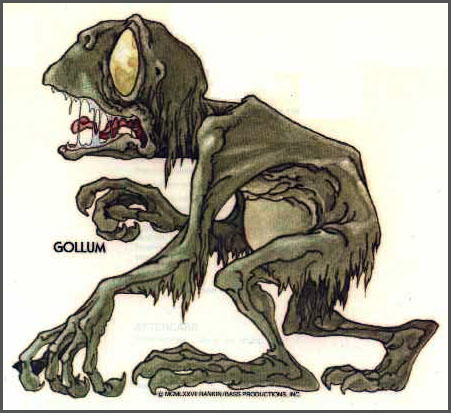
     The character of Beorn is completely omitted and instead the Eagles take the company to the very edge of Mirkwood. The Arkenstone is also not mentioned in the film; instead Thorin and the company are in love with the mere idea of all the treasure that is in the mountain and also reclaiming their family honor. Another major change is that at the end of the story Gandalf reviles what the ring is to Bilbo. That he found the One Ring and that it is very dangerous and important. There are also very distinct visual changes, the most obvious being that the wood elves skin is green and they are of a smaller stature, closer to that of the dwarves. But even with these changes it is still very accurate to the books. The art style is very unique with caricature like animation of Gollum and a very bushy eyed Gandalf. The art is a major point of interest to me and I’m sure many others. Things like smoke and fire are very swirly and distinct looking.
                       
     This adaptation has a lot of songs, most of which were in the book. They include, That’s What Bilbo Baggins Hates, The Lonely Mountain Song, The Goblin Song, Fifteen Birds in Five Fur Trees, and several other original songs. These songs give the movie a very fairytale like feel which is also fun for kids which is the target age group.

     I saw this movie as a child and loved it. It’s always had a strong connection to the book for me and it’s still very enjoyable to watch. The dialog comes almost straight from the books which is a great addition. The film really brings the story to life and I would encourage anyone who hasn’t seen it to get a copy and give it a try!     

Sunday, April 6, 2014

Harry Potter and the Sorcerer's Stone (2001)


There are so many aspects of this film that are worth looking at! I must admit to a strong bias, however, as this was the movie that propelled me into my 12-year-still-going-strong-love-affair with Harry Potter.

During this viewing of Sorcerer's Stone, several things stood out to me.

The first was the music. The magical world of the Harry Potter movies has no equal in recognition, and that is, in many ways, thanks to John Williams' original score. Every setting and scene has a particular sound; one that sticks in the viewer's head for days after hearing it. Music is so important to the film, however, that it can sometimes seem a bit overbearing. There were a few scenes, like the incessant score throughout the montage where the Dursleys attempt to keep Harry from his letter, where the music is a tad distracting. However, I suppose that lends itself well to the spirit of the film, where emotions are felt deeply and widely by a host of characters who experience new and overwhelming things. An effective movie score will take the audience through a range of emotions effortlessly, and that is what Williams' music accomplishes.

Secondly, I observed the brilliant casting for the movie. A cast so rich with British acting royalty shows an enthusiasm and belief in the project and the story. Not only were the roles perfectly cast, some of the best being Maggie Smith as Minerva McGonagall and Richard Griffiths as Vernon Dursley, but longevity was expected from each actor, especially the 11 year-olds they cast in the three main roles. This was an important and refreshing move, since, though not all of Rowling's books were released at the time of the making of the film, it was clear that this project would endure through the successive volumes of Harry's story, and the first film did well to set that goal up.


Thirdly, though I am not usually one to expect or even enjoy an adapted movie that is made to be exactly like the book (film and print are two very different mediums that one should not expect to mirror each other in every aspect), I did respect the way that Sorcerer's Stone held true to not only the spirit of Rowling's first novel, but maintained some of its most memorable quotes as well. I must admit that I saw the movie in theaters in second grade before I voraciously gobbled up the book, but the speed and hunger with which I read was attributable to the closeness of the screenplay with some of the best moments of the book. For instance, who can forget Hermione's exasperated admonition: "Now, if you two don't mind, I'm going back to bed before either of you come up with another clever idea to get us killed, or worse...expelled!" Or Snape's opening monologue on the first day of potions class? Those are taken from the book verbatim, and go a long way in both linking love for the movie with the book, and making the screenplay unforgettable.


"Inkheart" Film Review


            This time around, I have decided to review a movie that I have already seen many times.  I saw the movie version of Inkheart many years ago and I’ve always loved it, despite its poor reputation among critics. Before I go any further, I must clarify that I have not read the book, so I will not make distinctions between it and the film. There are two aspects of Inkheart that I want to focus on: (a) the magical power of text and the act of reading and (2) the relationship between the primary and secondary worlds.
            Inkheart is about a girl named Meggie and her father, Mortimer (Mo). Mo (and, as we find out later, Meggie) has the ability to read things and characters in and out of books. One night when Meggie was a baby, Mo was reading Inkheart aloud to her. Suddenly, characters from the book appeared in the primary world and Resa, Mo’s wife and Meggie’s mother, disappeared into the world of the book. From that point on, Mo refused to read aloud and tirelessly searched for a copy of the book so he could try to read Resa back out again.
            Upon re-viewing this film, I set out to analyze the power of text and reading. First of all, language is performative in Inkheart. Similar to speech acts like “I now pronounce you husband and wife” or “You’re fired,” Mo’s reading aloud makes things happen. Of course, in the story, we have an exaggeration of the performative power of language because it can employ magical power and cause physical phenomena. For example, in the opening scene, Mo is reading “Little Red Riding Hood” to Resa and Meggie and as he reads, a red cloak floats down from the sky and gets caught on a clothesline. Also, characters that aren’t smoothly read out of their books are left with text all over their skin; the reading process leaves its mark. This certainly lends itself to a reader-response analysis. The reader meets the text and the result is meaning. The reader “actualizes” the text, quite literally in Inkheart. The power is not inherent in the text but requires utterance, which clearly has some magical property, in order to be "enacted."
            I am also interested in the inversion of the primary world/secondary world relationship. We have read and viewed several texts in which characters travel from the primary world to a secondary world (The Lion, the Witch and the Wardrobe), or the primary world is revealed to contain magic (The Mortal Instruments), or the world of the narrative is purely secondary (The Hobbit). But we haven’t really explored the idea of a secondary world invading the primary world. In Inkheart, Silver Tongues, through the act of reading aloud, bring elements of secondary worlds into the primary world and vice versa. This raises an interesting question: what and where is the secondary world? Because Silver Tongues read things out of texts, where exactly are they coming from? Does each text create and inhabit a world? Is there one big magical world of fictional characters and objects out there somewhere (which would be pretty awesome, if I may say so myself)? We have to believe that, even its absence, the secondary world is real because we see traces of it manifest themselves, which is quite a deconstructive move (also think of the traces of text on some characters’ skin).
            In his review of the film, Roger Ebert, starts with the following statement: “I never knew reading could be so dangerous.” In most fantasy stories, narrative plays a major role, whether it's in the form of myth, history, physical texts, etc. In these stories, we come across many texts that speak of danger, but rarely does the act of reading them cause something to happen in such a tangible way. We know that readers have unique experiences with texts; now add magic to the mix—one this is certain: you’re in for one heck of a read.